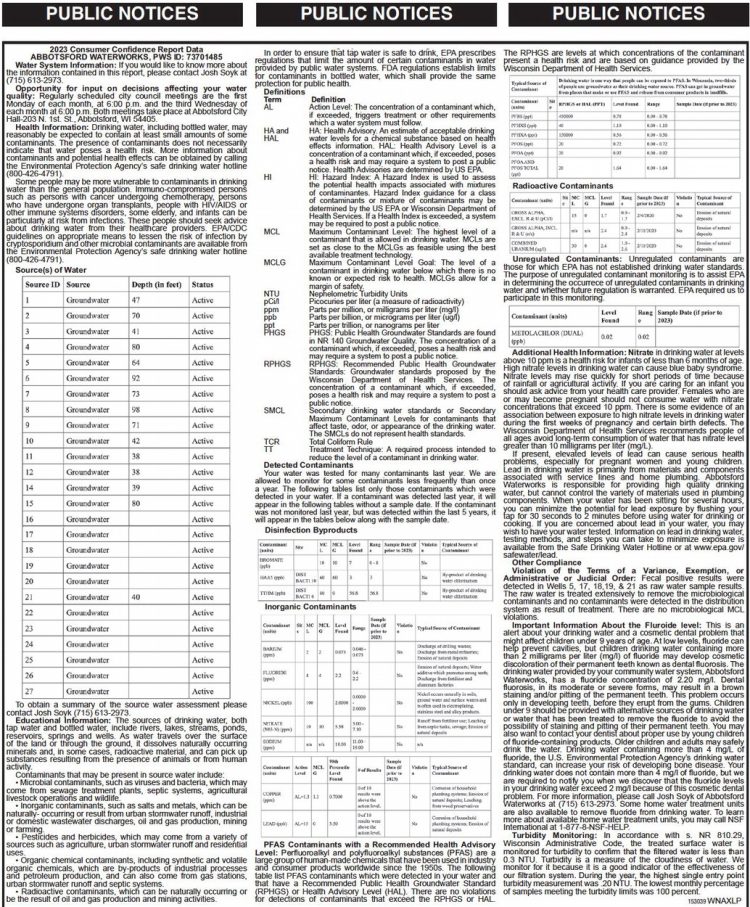
PUBLIC NOTICES PUBLIC NOTICES PUBLIC NOTICES g p g In order to ensure that tap water is safe to drink, EPA prescribes regulations that limit the amount of certain contaminants in water provided by public water systems. FDA regulations establish limits for contaminants in bottled water, which shall provide the same protection for public health. The RPHGS are levels at which concentrations of the contaminant present a health risk and are based on guidance provided by the Wisconsin Department of Health Services. Definitions Term Definition 2023 Consumer Confidence Report Data ABBOTSFORD WATERWORKS, PWS ID: 73701485 Water System Information: If you would like to know more about the information contained in this report, please contact Josh Soyk at (715) 613-2973. Opportunity for input on decisions affecting your water quality: Regularly scheduled city council meetings are the first Monday of each month, at 6:00 p.m. and the third Wednesday of each month at 6:00 p.m. Both meetings take place at Abbotsford City Hall-203 N. 1st. St., Abbotsford, WI 54405. Health Information: Drinking water, including bottled water, may reasonably be expected to contain at least small amounts of some contaminants. The presence of contaminants does not necessarily indicate that water poses a health risk. More information about contaminants and potential health effects can be obtained by calling the Environmental Protection Agency’s safe drinking water hotline (800-426-4791). Some people may be more vulnerable to contaminants in drinking water than the general population. Immuno-compromised persons such as persons with cancer undergoing chemotherapy, persons who have undergone organ transplants, people with HIV/AIDS or other immune systems disorders, some elderly, and infants can be particularly at risk from infections. These people should seek advice about drinking water from their healthcare providers. EPA/CDC guidelines on appropriate means to lessen the risk of infection by cryptosporidium and other microbial contaminants are available from the Environmental Protection Agency’s safe drinking water hotline (800-426-4791). Source(s) of Water Radioactive Contaminants AL Action Level: The concentration of a contaminant which, if exceeded, triggers treatment or other requirements which a water system must follow. HA and HA: Health Advisory. An estimate of acceptable drinking HAL water levels for a chemical substance based on health effects information. HAL: Health Advisory Level is a concentration of a contaminant which, if exceeded, poses a health risk and may require a system to post a public notice. Health Advisories are determined by US EPA. HI HI: Hazard Index: A Hazard Index is used to assess the potential health impacts associated with mixtures of contaminantes. Hazard Index guidance for a class of contaminants or mixture of contaminants may be determined by the US EPA or Wisconsin Department of Health Services. If a Health Index is exceeded, a system may be required to post a public notice. MCL Maximum Contaminant Level: The highest level of a contaminant that is allowed in drinking water. MCLs are set as close to the MCLGs as feasible using the best available treatment technology. MCLG Maximum Contaminant Level Goal: The level of a contaminant in drinking water below which there is no known or expected risk to health. MCLGs allow for a margin of safety. NTU Nephelometric Turbidity Units pCi/l Picocuries per liter (a measure of radioactivity) ppm Parts per million, or milligrams per liter (mg/l) ppb Parts per billion, or micrograms per liter (ug/l) ppt Parts per trillion, or nanograms per liter PHGS PHGS: Public Health Groundwater Standards are found in NR 140 Groundwater Quality. The concentration of a contaminant which, if exceeded, poses a health risk and may require a system to post a public notice. RPHGS RPHGS: Recommended Public Health Groundwater Standards: Groundwater standards proposed by the Wisconsin Department of Health Services. The concentration of a contaminant which, if exceeded, poses a health risk and may require a system to post a public notice. SMCL Secondary drinking water standards or Secondary Maximum Contaminant Levels for contaminants that affect taste, odor, or appearance of the drinking water. The SMCLs do not represent health standards. TCR Total Coliform Rule TT Treatment Technique: A required process intended to reduce the level of a contaminant in drinking water. Unregulated Contaminants: Unregulated contaminants are those for which EPA has not established drinking water standards. The purpose of unregulated contaminant monitoring is to assist EPA in determining the occurrece of unregulated contaminants in drinking water and whether future regulation is warranted. EPA required us to participate in this monitoring. Detected Contaminants Your water was tested for many contaminants last year. We are allowed to monitor for some contaminants less frequently than once a year. The following tables list only those contaminants which were detected in your water. If a contaminant was detected last year, it will appear in the following tables without a sample date. If the contaminant was not monitored last year, but was detected within the last 5 years, it will appear in the tables below along with the sample date. Disinfection Byproducts Inorganic Contaminants Additional Health Information: Nitrate in drinking water at levels above 10 ppm is a health risk for infants of less than 6 months of age. High nitrate levels in drinking water can cause blue baby syndrome. Nitrate levels may rise quickly for short periods of time because of rainfall or agricultural activity. If you are caring for an infant you should ask advice from your health care provider. Females who are or may become pregnant should not consume water with nitrate concentrations that exceed 10 ppm. There is some evidence of an association between exposure to high nitrate levels in drinking water during the first weeks of pregnancy and certain birth defects. The Wisconsin Department of Health Services recommends people of all ages avoid long-term consumption of water that has nitrate level greater than 10 milligrams per liter (mg/L). If present, elevated levels of lead can cause serious health problems, especially for pregnant women and young children. Lead in drinking water is primarily from materials and components associated with service lines and home plumbing. Abbotsford Waterworks is responsible for providing high quality drinking water, but cannot control the variety of materials used in plumbing components. When your water has been sitting for several hours, you can minimize the potential for lead exposure by flushing your tap for 30 seconds to 2 minutes before using water for drinking or cooking. If you are concerned about lead in your water, you may wish to have your water tested. Information on lead in drinking water, testing methods, and steps you can take to minimize exposure is available from the Safe Drinking Water Hotline or at www.epa.gov/ safewater/lead. Other Compliance Violation of the Terms of a Variance, Exemption, or Administrative or Judicial Order: Fecal positive results were detected in Wells 5, 17, 18,19, & 21 as raw water sample results. The raw water is treated extensively to remove the microbiological contaminants and no contaminants were detected in the distribution system as result of treatment. There are no microbiological MCL violations. Important Information About the Fluroide level: This is an alert about your drinking water and a cosmetic dental problem that might affect children under 9 years of age. At low levels, fluoride can help prevent cavities, but children drinking water containing more than 2 milligrams per liter (mg/l) of fluoride may develop cosmetic discoloration of their permanent teeth known as dental fluorosis. The drinking water provided by your community water system, Abbotsford Waterworks, has a fluoride concentration of 2.20 mg/l. Dental fluorosis, in its moderate or severe forms, may result in a brown staining and/or pitting of the permanent teeth. This problem occurs only in developing teeth, before they erupt from the gums. Children under 9 should be provided with alternative sources of drinking water or water that has been treated to remove the fluoride to avoid the possibility of staining and pitting of their permanent teeth. You may also want to contact your dentist about proper use by young children of fluoride-containing products. Older children and adults may safely drink the water. Drinking water containing more than 4 mg/L of fluoride, the U.S. Environmental Protection Agency's drinking water standard, can increase your risk of developing bone disease. Your drinking water does not contain more than 4 mg/l of fluoride, but we are required to notify you when we discover that the fluoride levels in your drinking water exceed 2 mg/l because of this cosmetic dental problem. For more information, please call Josh Soyk of Abbotsford Waterworks at (715) 613-2973. Some home water treatment units are also available to remove fluoride from drinking water. To learn more about available home water treatment units, you may call NSF International at 1-877-8-NSF-HELP. Turbidity Monitoring: In accordance with s. NR 810.29, Wisconsin Administrative Code, the treated surface water is monitored for turbidity to confirm that the filtered water is less than 0.3 NTU. Turbidity is a measure of the cloudiness of water. We monitor for it because it is a good indicator of the effectiveness of our filtration system. During the year, the highest single entry point turbidity measurement was .20 NTU. The lowest monthly percentage of samples meeting the turbidity limits was 100 percent. To obtain a summary of the source water assessment please contact Josh Soyk (715) 613-2973. Educational Information: The sources of drinking water, both tap water and bottled water, include rivers, lakes, streams, ponds, reservoirs, springs and wells. As water travels over the surface of the land or through the ground, it dissolves naturally occurring minerals and, in some cases, radioactive material, and can pick up substances resulting from the presence of animals or from human activity. Contaminants that may be present in source water include: • Microbial contaminants, such as viruses and bacteria, which may come from sewage treatment plants, septic systems, agricultural livestock operations and wildlife. • Inorganic contaminants, such as salts and metals, which can be naturally- occurring or result from urban stormwater runoff, industrial or domestic wastewater discharges, oil and gas production, mining or farming. • Pesticides and herbicides, which may come from a variety of sources such as agriculture, urban stormwater runoff and residential uses. • Organic chemical contaminants, including synthetic and volatile organic chemicals, which are by-products of industrial processes and petroleum production, and can also come from gas stations, urban stormwater runoff and septic systems. • Radioactive contaminants, which can be naturally occurring or be the result of oil and gas production and mining activities. PFAS Contaminants with a Recommended Health Advisory Level: Perfluoroalkyl and polyfluoroalkyl substances (PFAS) are a large group of human-made chemicals that have been used in industry and consumer products worldwide since the 1950s. The following table list PFAS contaminants which were detected in your water and that have a Recommended Public Health Groundwater Standard (RPHGS) or Health Advisory Level (HAL). There are no violations for detections of contaminants that exceed the RPHGS or HAL. 153039 WNAXLP PUBLIC NOTICES PUBLIC NOTICES PUBLIC NOTICES g p g In order to ensure that tap water is safe to drink, EPA prescribes regulations that limit the amount of certain contaminants in water provided by public water systems. FDA regulations establish limits for contaminants in bottled water, which shall provide the same protection for public health. The RPHGS are levels at which concentrations of the contaminant present a health risk and are based on guidance provided by the Wisconsin Department of Health Services. Definitions Term Definition 2023 Consumer Confidence Report Data ABBOTSFORD WATERWORKS, PWS ID: 73701485 Water System Information: If you would like to know more about the information contained in this report, please contact Josh Soyk at (715) 613-2973. Opportunity for input on decisions affecting your water quality: Regularly scheduled city council meetings are the first Monday of each month, at 6:00 p.m. and the third Wednesday of each month at 6:00 p.m. Both meetings take place at Abbotsford City Hall-203 N. 1st. St., Abbotsford, WI 54405. Health Information: Drinking water, including bottled water, may reasonably be expected to contain at least small amounts of some contaminants. The presence of contaminants does not necessarily indicate that water poses a health risk. More information about contaminants and potential health effects can be obtained by calling the Environmental Protection Agency’s safe drinking water hotline (800-426-4791). Some people may be more vulnerable to contaminants in drinking water than the general population. Immuno-compromised persons such as persons with cancer undergoing chemotherapy, persons who have undergone organ transplants, people with HIV/AIDS or other immune systems disorders, some elderly, and infants can be particularly at risk from infections. These people should seek advice about drinking water from their healthcare providers. EPA/CDC guidelines on appropriate means to lessen the risk of infection by cryptosporidium and other microbial contaminants are available from the Environmental Protection Agency’s safe drinking water hotline (800-426-4791). Source(s) of Water Radioactive Contaminants AL Action Level: The concentration of a contaminant which, if exceeded, triggers treatment or other requirements which a water system must follow. HA and HA: Health Advisory. An estimate of acceptable drinking HAL water levels for a chemical substance based on health effects information. HAL: Health Advisory Level is a concentration of a contaminant which, if exceeded, poses a health risk and may require a system to post a public notice. Health Advisories are determined by US EPA. HI HI: Hazard Index: A Hazard Index is used to assess the potential health impacts associated with mixtures of contaminantes. Hazard Index guidance for a class of contaminants or mixture of contaminants may be determined by the US EPA or Wisconsin Department of Health Services. If a Health Index is exceeded, a system may be required to post a public notice. MCL Maximum Contaminant Level: The highest level of a contaminant that is allowed in drinking water. MCLs are set as close to the MCLGs as feasible using the best available treatment technology. MCLG Maximum Contaminant Level Goal: The level of a contaminant in drinking water below which there is no known or expected risk to health. MCLGs allow for a margin of safety. NTU Nephelometric Turbidity Units pCi/l Picocuries per liter (a measure of radioactivity) ppm Parts per million, or milligrams per liter (mg/l) ppb Parts per billion, or micrograms per liter (ug/l) ppt Parts per trillion, or nanograms per liter PHGS PHGS: Public Health Groundwater Standards are found in NR 140 Groundwater Quality. The concentration of a contaminant which, if exceeded, poses a health risk and may require a system to post a public notice. RPHGS RPHGS: Recommended Public Health Groundwater Standards: Groundwater standards proposed by the Wisconsin Department of Health Services. The concentration of a contaminant which, if exceeded, poses a health risk and may require a system to post a public notice. SMCL Secondary drinking water standards or Secondary Maximum Contaminant Levels for contaminants that affect taste, odor, or appearance of the drinking water. The SMCLs do not represent health standards. TCR Total Coliform Rule TT Treatment Technique: A required process intended to reduce the level of a contaminant in drinking water. Unregulated Contaminants: Unregulated contaminants are those for which EPA has not established drinking water standards. The purpose of unregulated contaminant monitoring is to assist EPA in determining the occurrece of unregulated contaminants in drinking water and whether future regulation is warranted. EPA required us to participate in this monitoring. Detected Contaminants Your water was tested for many contaminants last year. We are allowed to monitor for some contaminants less frequently than once a year. The following tables list only those contaminants which were detected in your water. If a contaminant was detected last year, it will appear in the following tables without a sample date. If the contaminant was not monitored last year, but was detected within the last 5 years, it will appear in the tables below along with the sample date. Disinfection Byproducts Inorganic Contaminants Additional Health Information: Nitrate in drinking water at levels above 10 ppm is a health risk for infants of less than 6 months of age. High nitrate levels in drinking water can cause blue baby syndrome. Nitrate levels may rise quickly for short periods of time because of rainfall or agricultural activity. If you are caring for an infant you should ask advice from your health care provider. Females who are or may become pregnant should not consume water with nitrate concentrations that exceed 10 ppm. There is some evidence of an association between exposure to high nitrate levels in drinking water during the first weeks of pregnancy and certain birth defects. The Wisconsin Department of Health Services recommends people of all ages avoid long-term consumption of water that has nitrate level greater than 10 milligrams per liter (mg/L). If present, elevated levels of lead can cause serious health problems, especially for pregnant women and young children. Lead in drinking water is primarily from materials and components associated with service lines and home plumbing. Abbotsford Waterworks is responsible for providing high quality drinking water, but cannot control the variety of materials used in plumbing components. When your water has been sitting for several hours, you can minimize the potential for lead exposure by flushing your tap for 30 seconds to 2 minutes before using water for drinking or cooking. If you are concerned about lead in your water, you may wish to have your water tested. Information on lead in drinking water, testing methods, and steps you can take to minimize exposure is available from the Safe Drinking Water Hotline or at www.epa.gov/ safewater/lead. Other Compliance Violation of the Terms of a Variance, Exemption, or Administrative or Judicial Order: Fecal positive results were detected in Wells 5, 17, 18,19, & 21 as raw water sample results. The raw water is treated extensively to remove the microbiological contaminants and no contaminants were detected in the distribution system as result of treatment. There are no microbiological MCL violations. Important Information About the Fluroide level: This is an alert about your drinking water and a cosmetic dental problem that might affect children under 9 years of age. At low levels, fluoride can help prevent cavities, but children drinking water containing more than 2 milligrams per liter (mg/l) of fluoride may develop cosmetic discoloration of their permanent teeth known as dental fluorosis. The drinking water provided by your community water system, Abbotsford Waterworks, has a fluoride concentration of 2.20 mg/l. Dental fluorosis, in its moderate or severe forms, may result in a brown staining and/or pitting of the permanent teeth. This problem occurs only in developing teeth, before they erupt from the gums. Children under 9 should be provided with alternative sources of drinking water or water that has been treated to remove the fluoride to avoid the possibility of staining and pitting of their permanent teeth. You may also want to contact your dentist about proper use by young children of fluoride-containing products. Older children and adults may safely drink the water. Drinking water containing more than 4 mg/L of fluoride, the U.S. Environmental Protection Agency's drinking water standard, can increase your risk of developing bone disease. Your drinking water does not contain more than 4 mg/l of fluoride, but we are required to notify you when we discover that the fluoride levels in your drinking water exceed 2 mg/l because of this cosmetic dental problem. For more information, please call Josh Soyk of Abbotsford Waterworks at (715) 613-2973. Some home water treatment units are also available to remove fluoride from drinking water. To learn more about available home water treatment units, you may call NSF International at 1-877-8-NSF-HELP. Turbidity Monitoring: In accordance with s. NR 810.29, Wisconsin Administrative Code, the treated surface water is monitored for turbidity to confirm that the filtered water is less than 0.3 NTU. Turbidity is a measure of the cloudiness of water. We monitor for it because it is a good indicator of the effectiveness of our filtration system. During the year, the highest single entry point turbidity measurement was .20 NTU. The lowest monthly percentage of samples meeting the turbidity limits was 100 percent. To obtain a summary of the source water assessment please contact Josh Soyk (715) 613-2973. Educational Information: The sources of drinking water, both tap water and bottled water, include rivers, lakes, streams, ponds, reservoirs, springs and wells. As water travels over the surface of the land or through the ground, it dissolves naturally occurring minerals and, in some cases, radioactive material, and can pick up substances resulting from the presence of animals or from human activity. Contaminants that may be present in source water include: • Microbial contaminants, such as viruses and bacteria, which may come from sewage treatment plants, septic systems, agricultural livestock operations and wildlife. • Inorganic contaminants, such as salts and metals, which can be naturally- occurring or result from urban stormwater runoff, industrial or domestic wastewater discharges, oil and gas production, mining or farming. • Pesticides and herbicides, which may come from a variety of sources such as agriculture, urban stormwater runoff and residential uses. • Organic chemical contaminants, including synthetic and volatile organic chemicals, which are by-products of industrial processes and petroleum production, and can also come from gas stations, urban stormwater runoff and septic systems. • Radioactive contaminants, which can be naturally occurring or be the result of oil and gas production and mining activities. PFAS Contaminants with a Recommended Health Advisory Level: Perfluoroalkyl and polyfluoroalkyl substances (PFAS) are a large group of human-made chemicals that have been used in industry and consumer products worldwide since the 1950s. The following table list PFAS contaminants which were detected in your water and that have a Recommended Public Health Groundwater Standard (RPHGS) or Health Advisory Level (HAL). There are no violations for detections of contaminants that exceed the RPHGS or HAL. 153039 WNAXLP
We use cookies to ensure that we give you the best experience on our website. If you continue to use this site we will assume that you are happy with it.Ok