Russ Jablonsky, AAMS Financial Advisor 739 Clark St., Medford 715 748 6366 FINANCIAL FOCUS Consider family meeting to discuss estate plans inform your loved ones of the professionals involved in your estate plans, such as your attorney and your tax advisor. • Roles of everyone involved – Not only does a comprehensive estate plan involve moving parts, such as the necessary documents, but it also includes actual human beings who may need to take on different roles. You will need an executor for your will and, if you have a living trust, you’ll need a trustee. Even if you choose to serve as the initial trustee, you’ll still need to identify one or more successor trustees to take your place if you become incapacitated, or upon your death. Plus, you’ll need to name people to act as your power of attorney for health care and finances. Choosing the right people for these roles involves thought and sensitivity. Obviously, you want individuals who are competent and reliable, but you also need to be aware that some family members could feel slighted if others are assigned roles they feel they could do. By being aware of these possible conflicts, you can be better prepared to address them. Here’s one more suggestion: Let your family know that this initial meeting doesn’t mean the end of communications about your estate plans. Encourage your loved ones to contact you with questions whenever they want. You may need to hold additional family meetings in the future, but by laying the initial groundwork, you will have taken a big first step in establishing the legacy you’d like to leave. At some point, you’ll want to share your estate plans with your loved ones — and the first step in this process may be to hold a family meeting. The best time to hold this meeting is when you’re still in good mental and physical shape, and the enactment of your estate plans may well be years away. But what topics should you cover? Consider these main areas: • Your wishes — and those of your family. Use this meeting to introduce your estate plans and, in a basic sense, what you hope to accomplish with them — leave money to your family, support charitable groups and so on. You’ll want to emphasize that you want to be equitable in what you leave behind, but there may be issues that affect this decision, such as disparities in income between grown children or an allowance for a special-needs child. But you’ll also want to listen to what your family members want — and you might be surprised at what they tell you. Consider this: More than 80% of the millennial generation would rather know their parents are financially secure throughout their retirement, even if this means that their parents will pass on less money to them, according to an Edward Jones/Age Wave study. • Estate planning documents – At the time of your family meeting, you may or may not have already created your estate planning documents, but in either case, this would be a good time to discuss them. These documents may include a will, a living trust, financial power of attorney, health care power of attorney and possibly other arrangements. At a minimum, you’d like to give a general overview of what these documents mean, but at an initial family meeting, you don’t necessarily have to get too detailed. For example, you might not want to talk about specific inheritances. This is also an opportunity to This article was written by Edward Jones for use by your local Edward Jones Financial Advisor. Edward Jones, Member SIPC Making Sense of Investing 146039 Russ Jablonsky, AAMS Financial Advisor 739 Clark St., Medford 715 748 6366 FINANCIAL FOCUS Consider family meeting to discuss estate plans inform your loved ones of the professionals involved in your estate plans, such as your attorney and your tax advisor. • Roles of everyone involved – Not only does a comprehensive estate plan involve moving parts, such as the necessary documents, but it also includes actual human beings who may need to take on different roles. You will need an executor for your will and, if you have a living trust, you’ll need a trustee. Even if you choose to serve as the initial trustee, you’ll still need to identify one or more successor trustees to take your place if you become incapacitated, or upon your death. Plus, you’ll need to name people to act as your power of attorney for health care and finances. Choosing the right people for these roles involves thought and sensitivity. Obviously, you want individuals who are competent and reliable, but you also need to be aware that some family members could feel slighted if others are assigned roles they feel they could do. By being aware of these possible conflicts, you can be better prepared to address them. Here’s one more suggestion: Let your family know that this initial meeting doesn’t mean the end of communications about your estate plans. Encourage your loved ones to contact you with questions whenever they want. You may need to hold additional family meetings in the future, but by laying the initial groundwork, you will have taken a big first step in establishing the legacy you’d like to leave. At some point, you’ll want to share your estate plans with your loved ones — and the first step in this process may be to hold a family meeting. The best time to hold this meeting is when you’re still in good mental and physical shape, and the enactment of your estate plans may well be years away. But what topics should you cover? Consider these main areas: • Your wishes — and those of your family. Use this meeting to introduce your estate plans and, in a basic sense, what you hope to accomplish with them — leave money to your family, support charitable groups and so on. You’ll want to emphasize that you want to be equitable in what you leave behind, but there may be issues that affect this decision, such as disparities in income between grown children or an allowance for a special-needs child. But you’ll also want to listen to what your family members want — and you might be surprised at what they tell you. Consider this: More than 80% of the millennial generation would rather know their parents are financially secure throughout their retirement, even if this means that their parents will pass on less money to them, according to an Edward Jones/Age Wave study. • Estate planning documents – At the time of your family meeting, you may or may not have already created your estate planning documents, but in either case, this would be a good time to discuss them. These documents may include a will, a living trust, financial power of attorney, health care power of attorney and possibly other arrangements. At a minimum, you’d like to give a general overview of what these documents mean, but at an initial family meeting, you don’t necessarily have to get too detailed. For example, you might not want to talk about specific inheritances. This is also an opportunity to This article was written by Edward Jones for use by your local Edward Jones Financial Advisor. Edward Jones, Member SIPC Making Sense of Investing 146039
Members of the Taylor County Coordinated Community Response/Sexual Assault Response Team (CCR/SART) gathered at Northcentral Technical College in Medford on Tuesday, April 28, where they observed two virtual presentations by Josephine A. Lauren of Incest AWARE. During the first session, Lauren educated on supporting survivors and their families by using the best language available and better understanding the basics about causes and consequences of this type of abuse. The second session brought to light the stigma surrounding difficult and taboo topics. Pictured are (l. to r.) Sam Jerome, initial assessment social worker with Taylor County Human Services; Sam Gehrke, Stepping Stones; Amy Riegert, Aspirus Sexual Assault Nurse Examiner (SANE) coordinator; and Ashley Rourk, Stepping Stones. MANDEE ELLIS/THE STAR NEWS
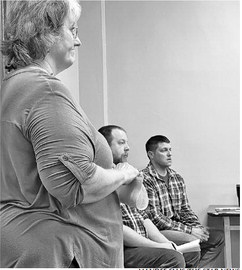
Taylor County registrar of Deeds Jaymi Kohn (left) reported to land information committee members that the register of deeds has about 60 agreements on file between county landowners and wind and solar companies. The county is urging property owners to get educated before they sign contracts. Information can be found at https://economicdevelopment.extension.wisc. edu/reset/#resources. MANDEE ELLIS/THE STAR NEWS
We use cookies to ensure that we give you the best experience on our website. If you continue to use this site we will assume that you are happy with it.Ok