An Outdoorsman’s Journal: Young biologistsVenison Processing - recordgleaner_20250813_trg-2025-08-13-0-014_art_0.xml
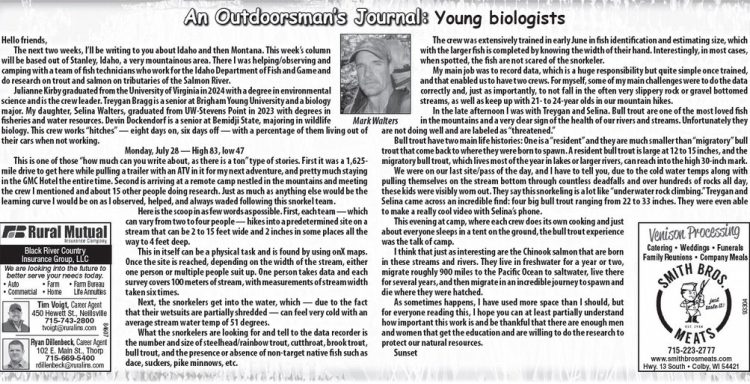
An Outdoorsman’s Journal: Young biologists Mark Walters The crew was extensively trained in early June in fish identification and estimating size, which with the larger fish is completed by knowing the width of their hand. Interestingly, in most cases, when spotted, the fish are not scared of the snorkeler. My main job was to record data, which is a huge responsibility but quite simple once trained, and that enabled us to have two crews. For myself, some of my main challenges were to do the data correctly and, just as importantly, to not fall in the often very slippery rock or gravel bottomed streams, as well as keep up with 21- to 24-year olds in our mountain hikes. In the late afternoon I was with Treygan and Selina. Bull trout are one of the most loved fish in the mountains and a very clear sign of the health of our rivers and streams. Unfortunately they are not doing well and are labeled as “threatened.” Bull trout have two main life histories: One is a“resident”and they are much smaller than“migratory”bull trout that come back to where they were born to spawn. A resident bull trout is large at 12 to 15 inches, and the migratory bull trout, which lives most of the year in lakes or larger rivers, can reach into the high 30-inch mark. We were on our last site/pass of the day, and I have to tell you, due to the cold water temps along with pulling themselves on the stream bottom through countless deadfalls and over hundreds of rocks all day, these kids were visibly worn out. They say this snorkeling is a lot like “underwater rock climbing.”Treygan and Selina came across an incredible find: four big bull trout ranging from 22 to 33 inches. They were even able to make a really cool video with Selina’s phone. This evening at camp, where each crew does its own cooking and just about everyone sleeps in a tent on the ground, the bull trout experience was the talk of camp. I think that just as interesting are the Chinook salmon that are born in these streams and rivers. They live in freshwater for a year or two, migrate roughly 900 miles to the Pacific Ocean to saltwater, live there for several years, and then migrate in an incredible journey to spawn and die where they were hatched. As sometimes happens, I have used more space than I should, but for everyone reading this, I hope you can at least partially understand how important this work is and be thankful that there are enough men and women that get the education and are willing to do the research to protect our natural resources. Sunset Hello friends, The next two weeks, I’ll be writing to you about Idaho and then Montana. This week’s column will be based out of Stanley, Idaho, a very mountainous area. There I was helping/observing and camping with a team of fish technicians who work for the Idaho Department of Fish and Game and do research on trout and salmon on tributaries of the Salmon River. Julianne Kirby graduated from the University of Virginia in 2024 with a degree in environmental science and is the crew leader. Treygan Bragg is a senior at Brigham Young University and a biology major. My daughter, Selina Walters, graduated from UW-Stevens Point in 2023 with degrees in fisheries and water resources. Devin Dockendorf is a senior at Bemidji State, majoring in wildlife biology. This crew works “hitches” — eight days on, six days off — with a percentage of them living out of their cars when not working. Monday, July 28 — High 83, low 47 This is one of those “how much can you write about, as there is a ton” type of stories. First it was a 1,625mile drive to get here while pulling a trailer with an ATV in it for my next adventure, and pretty much staying in the GMC Hotel the entire time. Second is arriving at a remote camp nestled in the mountains and meeting the crew I mentioned and about 15 other people doing research. Just as much as anything else would be the learning curve I would be on as I observed, helped, and always waded following this snorkel team. Here is the scoop in as few words as possible. First, each team — which can vary from two to four people — hikes into a predetermined site on a stream that can be 2 to 15 feet wide and 2 inches in some places all the way to 4 feet deep. This in itself can be a physical task and is found by using onX maps. Once the site is reached, depending on the width of the stream, either one person or multiple people suit up. One person takes data and each survey covers 100 meters of stream, with measurements of stream width taken six times. Next, the snorkelers get into the water, which — due to the fact that their wetsuits are partially shredded — can feel very cold with an average stream water temp of 51 degrees. What the snorkelers are looking for and tell to the data recorder is the number and size of steelhead/rainbow trout, cutthroat, brook trout, bull trout, and the presence or absence of non-target native fish such as dace, suckers, pike minnows, etc. Venison Processing Black River Country Insurance Group, LLC Catering • Weddings • Funerals Family Reunions • Company Meals We are looking into the future to better serve your needs today. • Auto • Commercial • Farm • Home • Farm Bureau Life Annuities Tim Voigt, Career Agent 93304 450 Hewett St., Neillsville 715-743-2800 School Sports Calendar tvoigt@ruralins.com 84607 Ryan Dillenbeck, Career Agent 102 E. Main St., Thorp 715-223-2777 715-669-5400 rdillenbeck@ruralins.com www.smithbrosmeats.com Hwy. 13 South • Colby, WI 54421 Granton Greenwood Loyal spencer An Outdoorsman’s Journal: Young biologists Mark Walters The crew was extensively trained in early June in fish identification and estimating size, which with the larger fish is completed by knowing the width of their hand. Interestingly, in most cases, when spotted, the fish are not scared of the snorkeler. My main job was to record data, which is a huge responsibility but quite simple once trained, and that enabled us to have two crews. For myself, some of my main challenges were to do the data correctly and, just as importantly, to not fall in the often very slippery rock or gravel bottomed streams, as well as keep up with 21- to 24-year olds in our mountain hikes. In the late afternoon I was with Treygan and Selina. Bull trout are one of the most loved fish in the mountains and a very clear sign of the health of our rivers and streams. Unfortunately they are not doing well and are labeled as “threatened.” Bull trout have two main life histories: One is a“resident”and they are much smaller than“migratory”bull trout that come back to where they were born to spawn. A resident bull trout is large at 12 to 15 inches, and the migratory bull trout, which lives most of the year in lakes or larger rivers, can reach into the high 30-inch mark. We were on our last site/pass of the day, and I have to tell you, due to the cold water temps along with pulling themselves on the stream bottom through countless deadfalls and over hundreds of rocks all day, these kids were visibly worn out. They say this snorkeling is a lot like “underwater rock climbing.”Treygan and Selina came across an incredible find: four big bull trout ranging from 22 to 33 inches. They were even able to make a really cool video with Selina’s phone. This evening at camp, where each crew does its own cooking and just about everyone sleeps in a tent on the ground, the bull trout experience was the talk of camp. I think that just as interesting are the Chinook salmon that are born in these streams and rivers. They live in freshwater for a year or two, migrate roughly 900 miles to the Pacific Ocean to saltwater, live there for several years, and then migrate in an incredible journey to spawn and die where they were hatched. As sometimes happens, I have used more space than I should, but for everyone reading this, I hope you can at least partially understand how important this work is and be thankful that there are enough men and women that get the education and are willing to do the research to protect our natural resources. Sunset Hello friends, The next two weeks, I’ll be writing to you about Idaho and then Montana. This week’s column will be based out of Stanley, Idaho, a very mountainous area. There I was helping/observing and camping with a team of fish technicians who work for the Idaho Department of Fish and Game and do research on trout and salmon on tributaries of the Salmon River. Julianne Kirby graduated from the University of Virginia in 2024 with a degree in environmental science and is the crew leader. Treygan Bragg is a senior at Brigham Young University and a biology major. My daughter, Selina Walters, graduated from UW-Stevens Point in 2023 with degrees in fisheries and water resources. Devin Dockendorf is a senior at Bemidji State, majoring in wildlife biology. This crew works “hitches” — eight days on, six days off — with a percentage of them living out of their cars when not working. Monday, July 28 — High 83, low 47 This is one of those “how much can you write about, as there is a ton” type of stories. First it was a 1,625mile drive to get here while pulling a trailer with an ATV in it for my next adventure, and pretty much staying in the GMC Hotel the entire time. Second is arriving at a remote camp nestled in the mountains and meeting the crew I mentioned and about 15 other people doing research. Just as much as anything else would be the learning curve I would be on as I observed, helped, and always waded following this snorkel team. Here is the scoop in as few words as possible. First, each team — which can vary from two to four people — hikes into a predetermined site on a stream that can be 2 to 15 feet wide and 2 inches in some places all the way to 4 feet deep. This in itself can be a physical task and is found by using onX maps. Once the site is reached, depending on the width of the stream, either one person or multiple people suit up. One person takes data and each survey covers 100 meters of stream, with measurements of stream width taken six times. Next, the snorkelers get into the water, which — due to the fact that their wetsuits are partially shredded — can feel very cold with an average stream water temp of 51 degrees. What the snorkelers are looking for and tell to the data recorder is the number and size of steelhead/rainbow trout, cutthroat, brook trout, bull trout, and the presence or absence of non-target native fish such as dace, suckers, pike minnows, etc. Venison Processing Black River Country Insurance Group, LLC Catering • Weddings • Funerals Family Reunions • Company Meals We are looking into the future to better serve your needs today. • Auto • Commercial • Farm • Home • Farm Bureau Life Annuities Tim Voigt, Career Agent 93304 450 Hewett St., Neillsville 715-743-2800 School Sports Calendar tvoigt@ruralins.com 84607 Ryan Dillenbeck, Career Agent 102 E. Main St., Thorp 715-223-2777 715-669-5400 rdillenbeck@ruralins.com www.smithbrosmeats.com Hwy. 13 South • Colby, WI 54421 Granton Greenwood Loyal spencer
Shed antler locations are rarely random. Bucks tend to drop them where they spend the most time during late winter, especially in areas that combine food, cover and security. WISCONSIN DNR PHOTO
Since the hunter education program’s creation in 1967, more than 20,000 volunteer instructors have trained and certified more than 1 million hunters across Wisconsin. WISCONSIN DNR PHOTO
We use cookies to ensure that we give you the best experience on our website. If you continue to use this site we will assume that you are happy with it.Ok