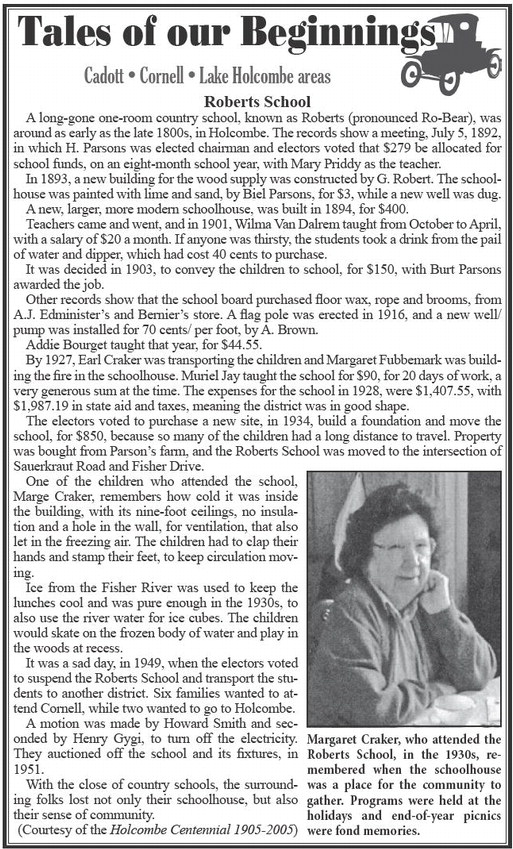
Tales of our Beginnings Cadott • Cornell • Lake Holcombe areas Roberts School A long-gone one-room country school, known as Roberts (pronounced Ro-Bear), was around as early as the late 1800s, in Holcombe. The records show a meeting, July 5, 1892, in which H. Parsons was elected chairman and electors voted that $279 be allocated for school funds, on an eight-month school year, with Mary Priddy as the teacher. In 1893, a new building for the wood supply was constructed by G. Robert. The schoolhouse was painted with lime and sand, by Biel Parsons, for $3, while a new well was dug. A new, larger, more modern schoolhouse, was built in 1894, for $400. Teachers came and went, and in 1901, Wilma Van Dalrem taught from October to April, with a salary of $20 a month. If anyone was thirsty, the students took a drink from the pail of water and dipper, which had cost 40 cents to purchase. It was decided in 1903, to convey the children to school, for $150, with Burt Parsons awarded the job. Other records show that the school board purchased floor wax, rope and brooms, from A.J. Edminister’s and Bernier’s store. A flag pole was erected in 1916, and a new well/ pump was installed for 70 cents/ per foot, by A. Brown. Addie Bourget taught that year, for $44.55. By 1927, Earl Craker was transporting the children and Margaret Fubbemark was building the fire in the schoolhouse. Muriel Jay taught the school for $90, for 20 days of work, a very generous sum at the time. The expenses for the school in 1928, were $1,407.55, with $1,987.19 in state aid and taxes, meaning the district was in good shape. The electors voted to purchase a new site, in 1934, build a foundation and move the school, for $850, because so many of the children had a long distance to travel. Property was bought from Parson’s farm, and the Roberts School was moved to the intersection of Sauerkraut Road and Fisher Drive. One of the children who attended the school, Marge Craker, remembers how cold it was inside the building, with its nine-foot ceilings, no insulation and a hole in the wall, for ventilation, that also let in the freezing air. The children had to clap their hands and stamp their feet, to keep circulation moving. Ice from the Fisher River was used to keep the lunches cool and was pure enough in the 1930s, to also use the river water for ice cubes. The children would skate on the frozen body of water and play in the woods at recess. It was a sad day, in 1949, when the electors voted to suspend the Roberts School and transport the students to another district. Six families wanted to attend Cornell, while two wanted to go to Holcombe. A motion was made by Howard Smith and seconded by Henry Gygi, to turn off the electricity. They auctioned off the school and its fixtures, in 1951. With the close of country schools, the surrounding folks lost not only their schoolhouse, but also their sense of community. (Courtesy of the Holcombe Centennial 1905-2005) Margaret Craker, who attended the Roberts School, in the 1930s, remembered when the schoolhouse was a place for the community to gather. Programs were held at the holidays and end-of-year picnics were fond memories. Tales of our Beginnings Cadott • Cornell • Lake Holcombe areas Roberts School A long-gone one-room country school, known as Roberts (pronounced Ro-Bear), was around as early as the late 1800s, in Holcombe. The records show a meeting, July 5, 1892, in which H. Parsons was elected chairman and electors voted that $279 be allocated for school funds, on an eight-month school year, with Mary Priddy as the teacher. In 1893, a new building for the wood supply was constructed by G. Robert. The schoolhouse was painted with lime and sand, by Biel Parsons, for $3, while a new well was dug. A new, larger, more modern schoolhouse, was built in 1894, for $400. Teachers came and went, and in 1901, Wilma Van Dalrem taught from October to April, with a salary of $20 a month. If anyone was thirsty, the students took a drink from the pail of water and dipper, which had cost 40 cents to purchase. It was decided in 1903, to convey the children to school, for $150, with Burt Parsons awarded the job. Other records show that the school board purchased floor wax, rope and brooms, from A.J. Edminister’s and Bernier’s store. A flag pole was erected in 1916, and a new well/ pump was installed for 70 cents/ per foot, by A. Brown. Addie Bourget taught that year, for $44.55. By 1927, Earl Craker was transporting the children and Margaret Fubbemark was building the fire in the schoolhouse. Muriel Jay taught the school for $90, for 20 days of work, a very generous sum at the time. The expenses for the school in 1928, were $1,407.55, with $1,987.19 in state aid and taxes, meaning the district was in good shape. The electors voted to purchase a new site, in 1934, build a foundation and move the school, for $850, because so many of the children had a long distance to travel. Property was bought from Parson’s farm, and the Roberts School was moved to the intersection of Sauerkraut Road and Fisher Drive. One of the children who attended the school, Marge Craker, remembers how cold it was inside the building, with its nine-foot ceilings, no insulation and a hole in the wall, for ventilation, that also let in the freezing air. The children had to clap their hands and stamp their feet, to keep circulation moving. Ice from the Fisher River was used to keep the lunches cool and was pure enough in the 1930s, to also use the river water for ice cubes. The children would skate on the frozen body of water and play in the woods at recess. It was a sad day, in 1949, when the electors voted to suspend the Roberts School and transport the students to another district. Six families wanted to attend Cornell, while two wanted to go to Holcombe. A motion was made by Howard Smith and seconded by Henry Gygi, to turn off the electricity. They auctioned off the school and its fixtures, in 1951. With the close of country schools, the surrounding folks lost not only their schoolhouse, but also their sense of community. (Courtesy of the Holcombe Centennial 1905-2005) Margaret Craker, who attended the Roberts School, in the 1930s, remembered when the schoolhouse was a place for the community to gather. Programs were held at the holidays and end-of-year picnics were fond memories.
We use cookies to ensure that we give you the best experience on our website. If you continue to use this site we will assume that you are happy with it.Ok